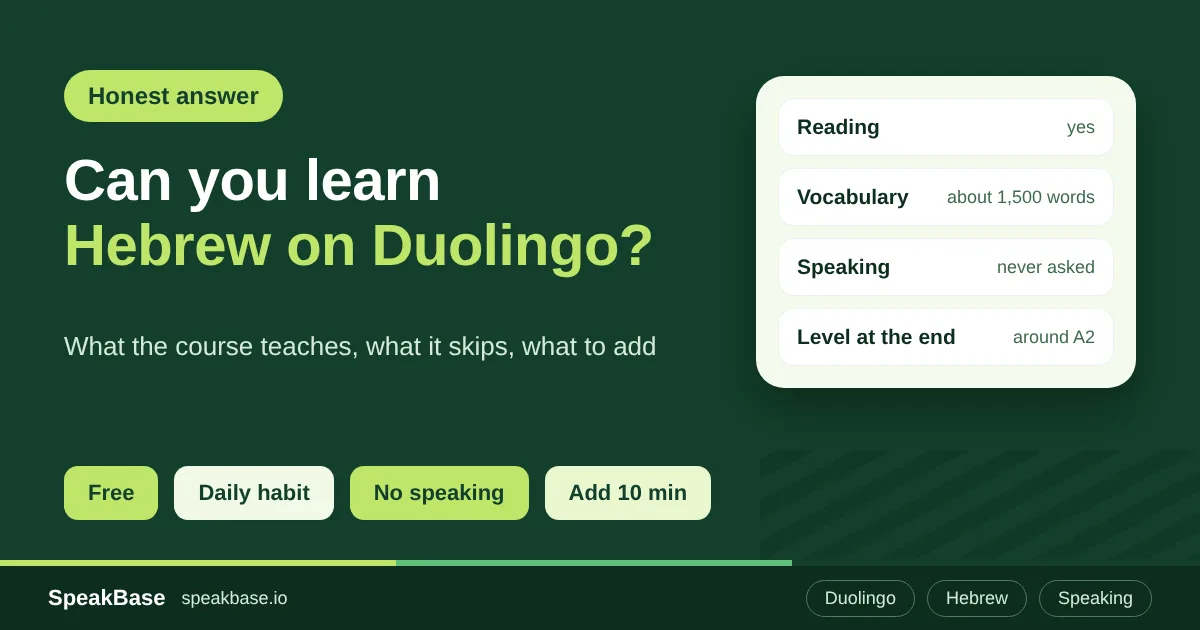
Short answer: yes, you can learn Hebrew on Duolingo, up to a point, and the point is well before conversation. The Duolingo Hebrew course will teach you to read, give you a few hundred words and the basic sentence patterns, and keep you coming back every day. It will not teach you to speak, because it never asks you to. Finish the course and you will understand a menu, a street sign and a simple text message, and freeze when an Israeli asks you a question.
That is not a reason to skip it. It is a reason to know what it is.
What the Duolingo Hebrew course actually covers
Duolingo offers one Hebrew course, from English, and it is free. The paid tiers remove ads and add unlimited mistakes (Super, about $13 a month or $84 a year in the US) or AI explanations and video calls (Max, about $30 a month). More on Max below, because it matters for Hebrew specifically.
The course starts with the alphabet and takes you through present, past and future tense, mostly in the basic pa'al verb pattern, with the usual Duolingo themes: food, family, travel, work, and a few units on Israeli holidays and places. Learners who finish report somewhere in the region of 1,500 to 2,000 words and a level around A2 on the European scale, which is "I can handle simple, routine exchanges".
Two things set the Hebrew course apart from Duolingo's big courses, and both come from how it was made. It was built by volunteer contributors, not by Duolingo's in-house team, and its audio was recorded by people rather than generated by a synthetic voice.
The four things Duolingo Hebrew does not do
1. It never asks you to speak
This is the big one. The Hebrew course has no speaking exercises. Duolingo's microphone exercises, where you read a sentence aloud and the app checks it, depend on speech recognition the Hebrew course does not have; its audio was recorded by people, and the course was built without a speaking component. In months of daily lessons you will never once say a Hebrew sentence and have anything check it. You can complete the entire course in silence.
Speaking is a different skill from reading. It happens in real time, with someone waiting, and it requires producing the right form, not recognizing it among four options. No amount of tapping builds it. If your goal is a conversation, the Duolingo course cannot get you there on its own, and it does not claim to.
2. New words often appear without vowels, and sometimes without audio
Hebrew is normally written without vowel points, and Duolingo follows that convention from early on. For a reader who already knows how a word sounds that is correct. For a learner meeting the word for the first time it means guessing. Learners regularly report new words shown with neither vowel points nor audio, so they look up the pronunciation elsewhere. Full sentences usually do have recorded audio, and the voices are native and pleasant; single words are the gap.
3. Nobody tells you why
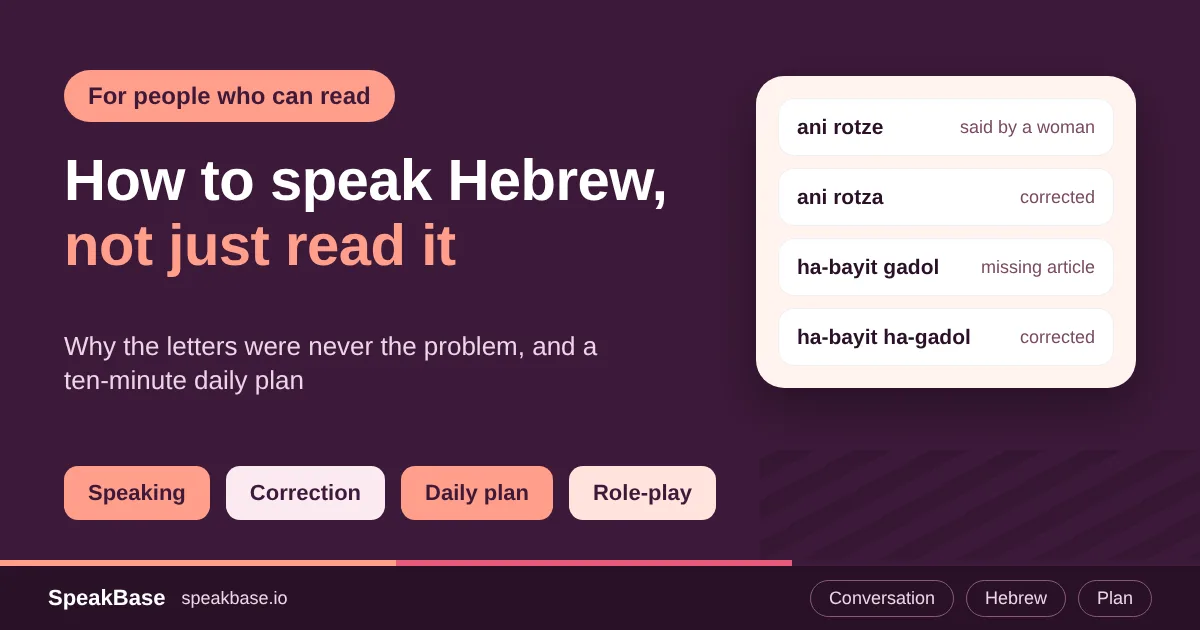
Duolingo's method is to let you infer the grammar from examples, with short notes in some units. For Spanish that works. For Hebrew, with its gendered verbs and adjectives, seven verb patterns, and prepositions that attach to words, learners end up with a feeling for what sounds right and no idea what rule they broke. The same mistake repeats for months. The sentence "at rotze" (a feminine "you" with a masculine "want") is marked wrong once and then never spoken aloud, so it never gets fixed in your mouth.
4. Duolingo Max's conversation features do not cover Hebrew
Duolingo Max adds "Explain My Answer" and Video Call, an AI character you talk to. When Video Call launched it supported English, Spanish, French, German, Italian and Portuguese, with Japanese and Korean added on iOS. Hebrew is not on the list. So the one Duolingo feature that would address the speaking gap is unavailable for the one course that needs it most. Check the app before paying for Max expecting Hebrew conversations.
What Duolingo Hebrew does well
It would be dishonest to leave it there, because the course has real strengths and millions of people use it for good reasons.
It builds the daily habit. The streak, the reminders and the short lessons get people to open a Hebrew app every day for months. No other app on the market does this as reliably, and habit is most of the battle.
It teaches you to read. Letters, final forms, the vav and yud spelling conventions. Graduates read Hebrew, slowly.
It is free. A complete beginner course at no cost, with native audio on the sentences.
It teaches Modern Israeli Hebrew. Not prayer-book Hebrew: the words you learn are the words on a Tel Aviv menu, and the cultural units are about Israel today.
The humor. The sentences are frequently absurd, which is why people remember them.
So, can you learn Hebrew on Duolingo?
You can learn to read Hebrew and recognize a basic vocabulary on Duolingo. You cannot learn to speak it there, and the course was not built to try.
The honest comparison is with a Hebrew school education: years of it produce American adults who can decode the letters and cannot hold a conversation, because decoding was what was practiced. Duolingo produces the same result faster and more cheaply. The missing ingredient is identical: producing Hebrew out loud, under time pressure, with someone catching the mistakes.
What to add: ten minutes of actual speaking a day
Keep Duolingo. It is free, it keeps you coming back, and the words it gives you are the words you will need. Then add the thing it skips.
The cheapest version is a language partner on an exchange app, if you can find a patient Israeli who wants your English and will correct your Hebrew. The most effective human version is a tutor on italki or Preply, at $10 to $40 an hour, once or twice a week.
The daily version, which is the one that actually changes what comes out of your mouth, is a spoken lesson with correction every day. That is what SpeakBase's Hebrew conversation practice was built for: you talk with Kate, an AI tutor who speaks Modern Israeli Hebrew, she corrects what you say in the moment and explains the correction in English, and tomorrow's lesson starts from yesterday's mistakes. Ten minutes a day is the dose. The first conversation is free, five minutes, no card, which is enough to find out how much of your Duolingo Hebrew you can actually say.
Have your first Hebrew conversation, free
A realistic plan for a Duolingo learner who can already read:
Duolingo, one lesson a day, as before. Vocabulary and reading.
A ten-minute spoken lesson a day, where you are corrected. Speaking and listening.
Review your own corrected mistakes for five minutes. The gendered forms, the article, the preposition.
After a month, take a free three-minute Hebrew level test and compare it with where Duolingo says you are. The gap between the two numbers is the gap between recognition and production.
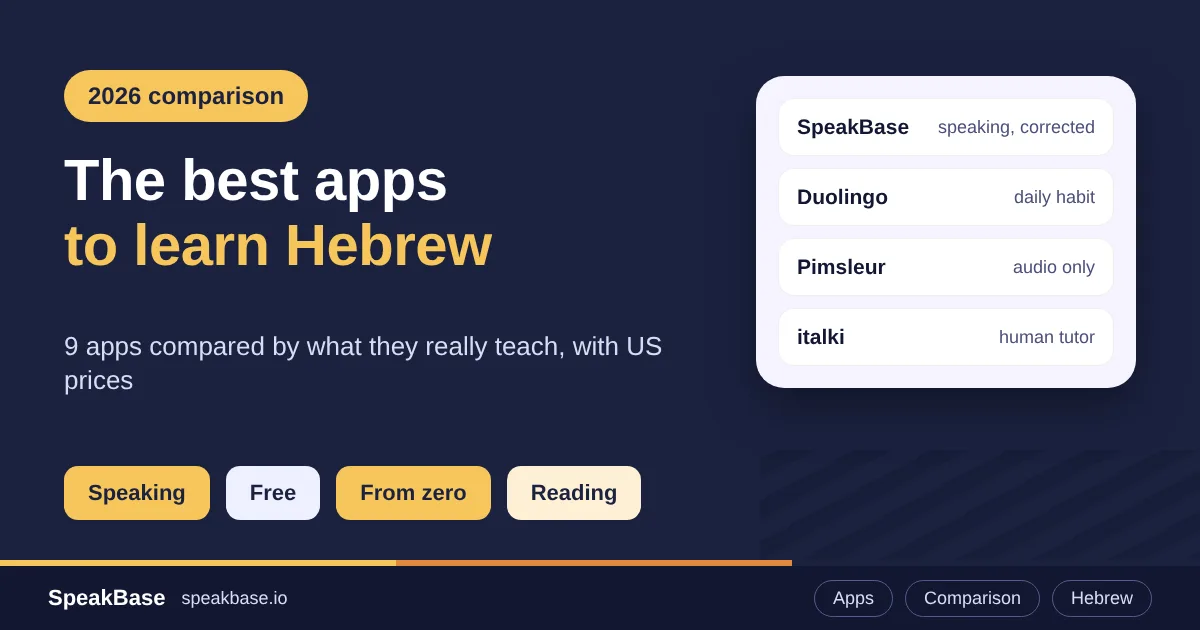
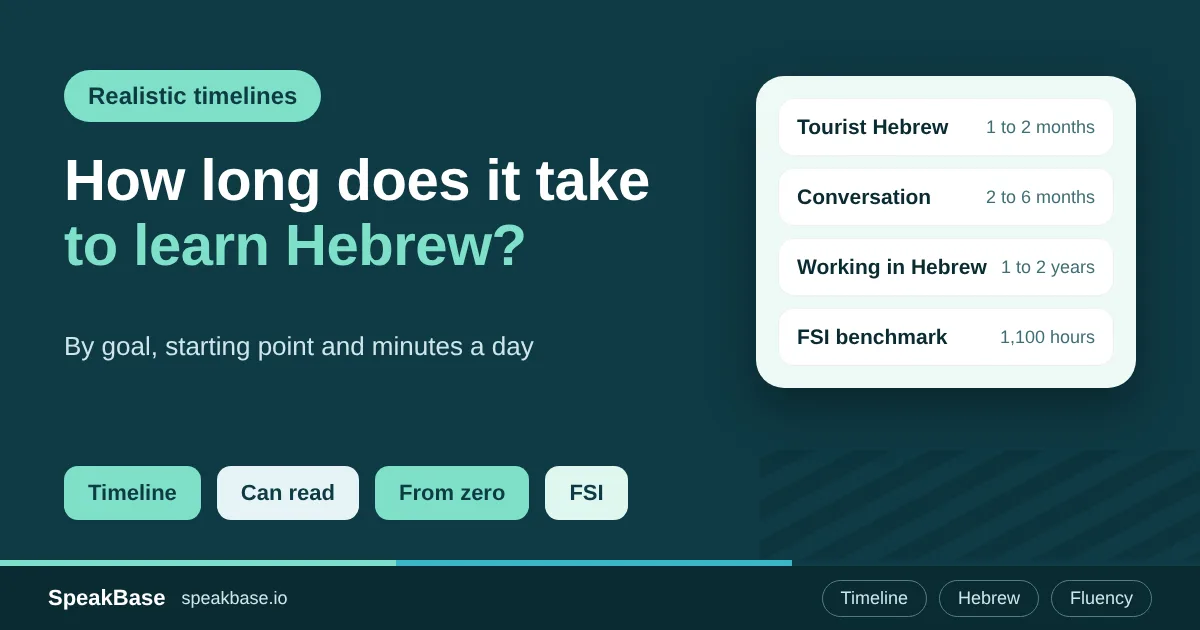
If you are weighing other apps too, our comparison of the best apps to learn Hebrew covers nine of them by what each one trains, and how long it takes to learn Hebrew gives the timelines.
FAQ about Duolingo Hebrew
Is Duolingo good for learning Hebrew?
Good for reading, basic vocabulary and daily habit; not good for speaking or listening to real-speed Hebrew. It is a fine first step and a poor last one.
How long does the Duolingo Hebrew course take?
Most learners who finish report six months to a year of daily lessons, depending on how many lessons a day. Learners also report that the Hebrew course takes noticeably more repetition than Duolingo's European language courses.
What level is Duolingo Hebrew?
Around A2 at the end of the course: simple routine exchanges, familiar topics. Reading is usually stronger than that; speaking is usually weaker, because it is never practiced.
Does Duolingo Hebrew teach vowels (nikkud)?
Partly. Vowel points appear in the early alphabet material and then mostly disappear, as in real Hebrew text. Learners frequently meet new words with no vowels and no audio for the single word.
Does Duolingo Hebrew have speaking exercises?
No. The Hebrew course was built without speaking exercises; nothing in it listens to you.
Is Duolingo Max worth it for Hebrew?
Not for conversation. The Video Call feature that lets you talk with an AI character is not available for Hebrew. "Explain My Answer" works, but $30 a month is a lot for explanations.
Is Duolingo Hebrew Modern or Biblical Hebrew?
Modern Israeli Hebrew. If you want Biblical Hebrew, Duolingo is the wrong tool; if you learned Biblical Hebrew in synagogue, your reading transfers and most of the vocabulary does not.