Written by the SpeakBase team. Updated October 2026; prices checked on October 10, 2026. Transparency: SpeakBase, one of the apps in this list, was built by our team in Israel. That is why its weaknesses are in here next to its strengths.
Searching for a Hebrew learning app is easy. Choosing one is the hard part, because almost every app says it is the best, almost every app has a free tier, and almost none of them say what they will not teach you. The truth is that there is no single best app to learn Hebrew for everyone. The right app for someone who has never seen the alphabet is not the right app for someone who read Torah at their bar mitzvah and still cannot order coffee in Tel Aviv.
This guide compares nine apps by the one thing that matters: what each app actually trains. Reading, vocabulary, listening or speaking. By the end you will know which one fits where you are, and how to combine two of them so that you end up talking, not just tapping.
Short answer: which app is best for learning Hebrew?
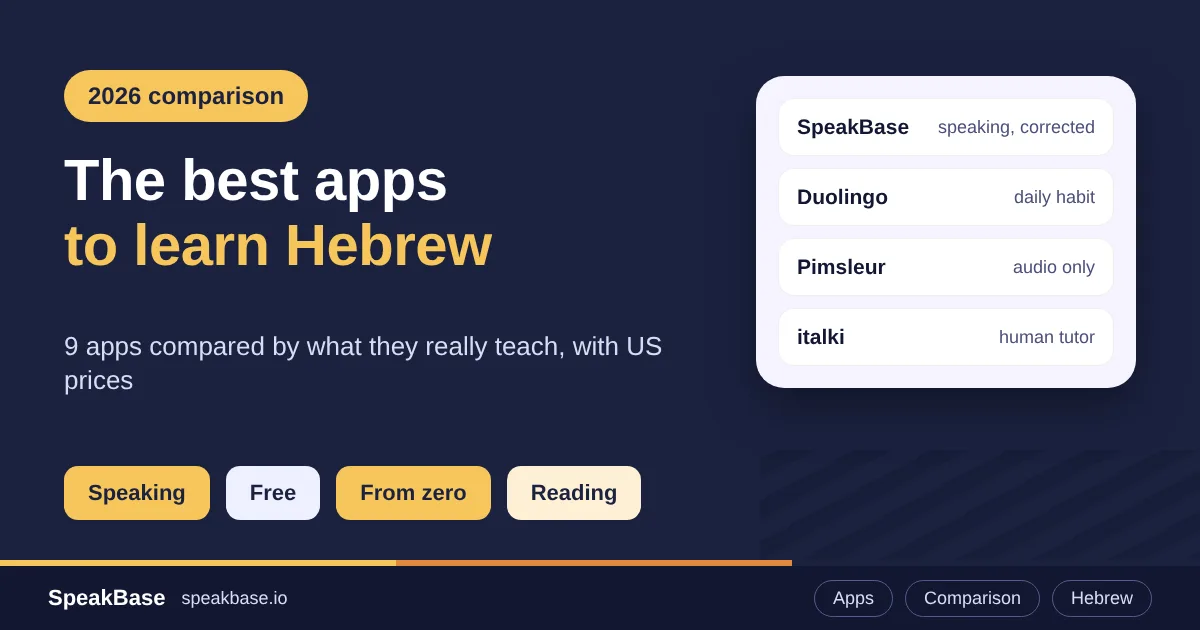
To speak Hebrew out loud with corrections, explained in English: SpeakBase. Live voice conversation with an AI tutor who catches the masculine and feminine forms you get wrong; the first conversation is free.
To build a daily habit and the first few hundred words: Duolingo. Free, fun, and it will not make you speak.
To learn pronunciation by ear during a commute: Pimsleur. Audio only, no screen, good rhythm, old-fashioned.
To understand how the language works, with grammar explained: HebrewPod101. Big library, weak on speaking.
To learn the alphabet in two weeks: the alphabet unit of Mango or Duolingo, then move on.
To practice with a real person: italki or Preply. Priced by the hour, so best as a weekly check, not a daily habit.
The one question to ask before you download anything
Can you read Hebrew?
It changes everything. A large share of American Jews learned to decode Hebrew letters as children; the Pew Research Center's 2013 survey found about half of US Jews know the Hebrew alphabet, while only 13% understand most of what they read. If that is you, an app that spends its first month on the alphabet is wasting your time, and what you need is an app that makes you produce sentences. If you cannot read at all, you need two weeks on the letters first, and then the same thing: production.
Most Hebrew apps are built for the first group of problems (recognition) and sold to people with the second (production). Keep that in mind as you read the comparison.
The 9 apps, compared
App | Best for | Makes you speak | Corrects your mistakes | US price (Oct 2026) |
SpeakBase | Spoken conversation, corrected, explained in English | Yes, live voice | Yes, in the moment | First talk free, then $11.99/mo or $119.99/yr |
Duolingo | Daily habit, first words, reading | No (the Hebrew course has no speaking exercises) | Multiple choice only | Free; Super about $13/mo or $84/yr |
Pimsleur | Pronunciation by ear, commuting | You repeat after audio, nobody listens | No | About $15 to $21/mo |
HebrewPod101 | Grammar explanations, listening, culture | No | No | $8 to $47/mo |
Mango Languages | Phrases and structure for travel | Record and compare yourself | No | $11.99/mo, often free via a US library card |
Rosetta Stone | Picture-based vocabulary | Speech recognition on single words | Only pronunciation score | About $179 to $199 lifetime |
Memrise / Anki | Vocabulary with spaced repetition | No | No | Free to about $9/mo |
Drops / Ling | Five minutes of words a day | No | No | Free tier, then about $10 to $14/mo |
italki / Preply | Real human conversation | Yes | Yes, if the tutor is good | $10 to $40 per hour |
1. SpeakBase: for speaking Hebrew, with someone catching every "ata" and "at"
What it is: a conversation app. You open it, press one button and talk with Kate, an AI tutor who speaks Modern Israeli Hebrew, listens to you and corrects what you say, then explains the correction in English. Ten minutes a day is the intended dose. Your mistakes become review cards, so the thing you got wrong today comes back tomorrow.
Who it is for: anyone who can already read a little Hebrew, or has done the alphabet elsewhere, and now freezes when a real person asks them a question. That is most Hebrew school graduates, most Birthright alumni, most people with an Israeli partner.
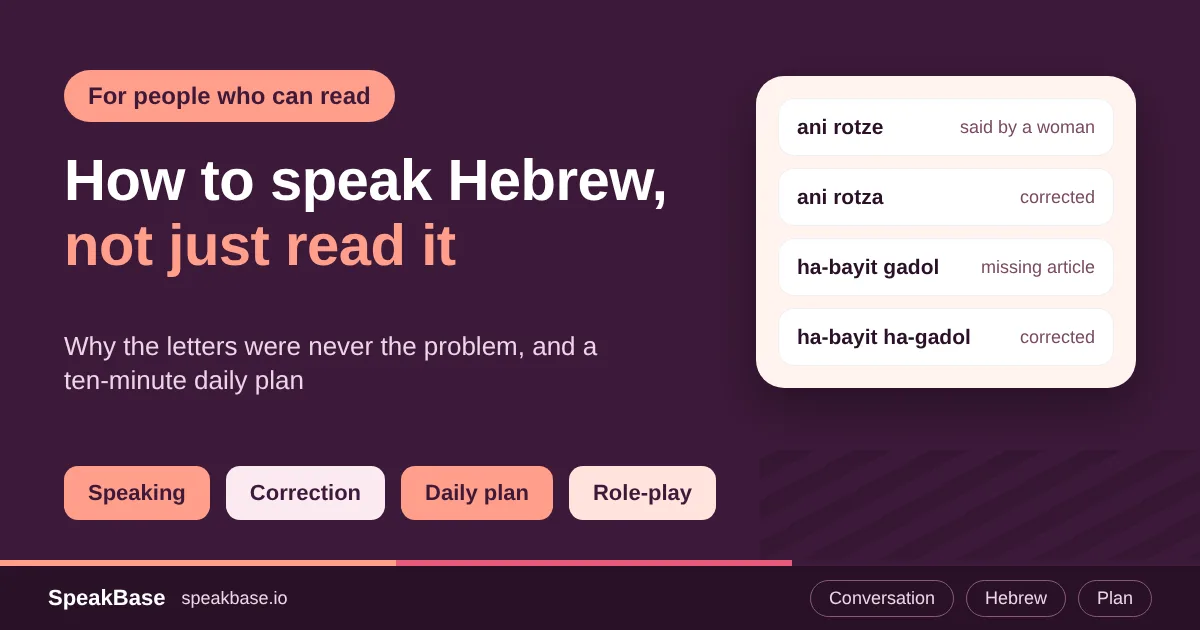
What it does well: it makes you produce full sentences under time pressure, which is the skill every other app on this list skips. Hebrew marks gender on verbs and adjectives (rotze to a man, rotza to a woman, spelled with the same letters) and an English speaker gets it wrong in nearly every sentence until someone corrects it in the moment. That correction, repeated daily, is the whole point. Kate also runs role-plays: the falafel stand, the taxi, the doctor, Shabbat dinner with your partner's family.
What it does not do: it is not an alphabet course and it is not a grammar textbook. If you cannot read at all, do two weeks of letters first. There is no human on the other end, which is a feature for the shy and a limitation for the advanced.
Price: the first conversation is free, five minutes, no card. After that $119.99 a year or $11.99 a month, in US dollars.
Our honest note: we built it, so weigh this entry accordingly. The free first conversation is the test; if you do not speak more Hebrew in those five minutes than in your last month of another app, close the tab.
Try a free Hebrew conversation with Kate
2. Duolingo: the habit app, with a Hebrew course that never asks you to speak
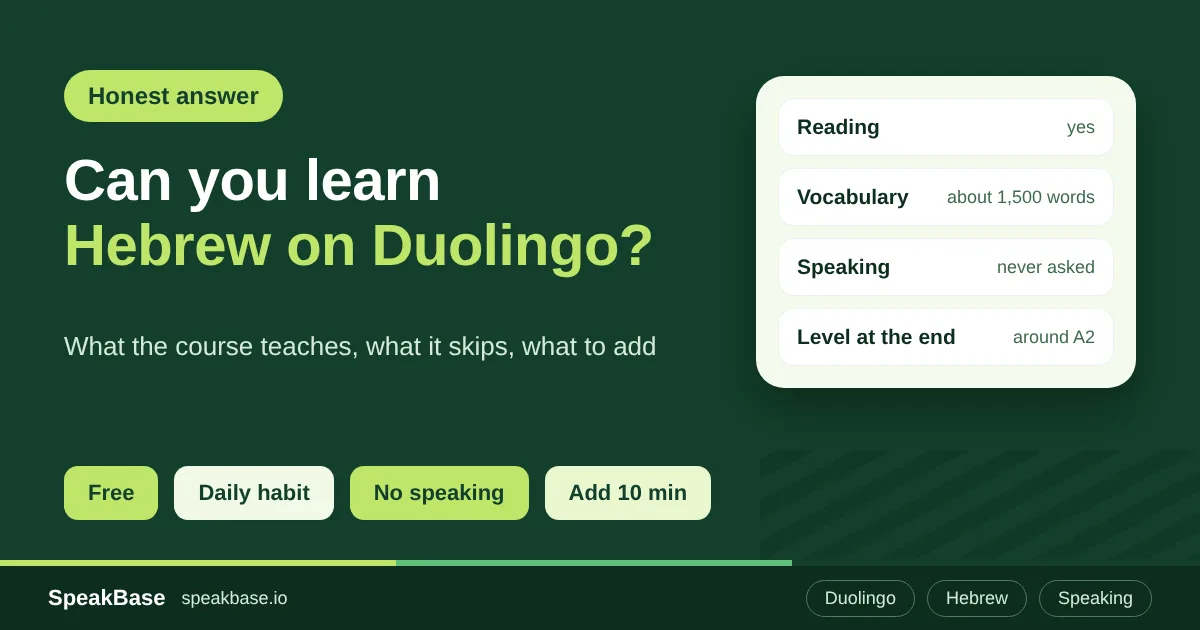
Duolingo has a free English-to-Hebrew course, and it is the app most people try first. It is good at exactly one thing, which is getting you to open it every day. The streak works, the owl works, and after three months you will recognize a few hundred words and the shape of present-tense sentences.
Here is what people find out later. The Hebrew course was built by volunteers with recorded audio rather than a synthetic voice, which gives it pleasant native voices on full sentences and no audio at all on many single words. New words are shown without vowel points, so you often meet a word and do not know how to say it. And the course has no speaking exercises: nothing in it listens to you, so nothing checks whether your Hebrew comes out right. Even Duolingo Max, the $30-a-month tier with AI video calls, does not offer its conversation features for Hebrew; as of its launch they cover English, Spanish, French, German, Italian and Portuguese, with Japanese and Korean on iOS.
Verdict: keep Duolingo as your free daily vocabulary habit. Do not expect to speak at the end of it. We wrote a full piece on this: can you learn Hebrew on Duolingo.
3. Pimsleur: thirty minutes of audio a day, for the ear
Pimsleur is the opposite of Duolingo. No screen, no gamification, no reading. Thirty-minute audio lessons in which a narrator teaches you a phrase, waits, and expects you to say it out loud. Hebrew has three levels of thirty lessons each.
It is excellent for pronunciation and for the rhythm of real Hebrew sentences, and it is the best app on this list for a commute. Its limits are structural: nobody hears what you say, so a wrong answer sounds exactly like a right one; the vocabulary is formal and a little dated; and after level three you are on your own. Subscriptions run from about $15 to $21 a month depending on the plan.
Verdict: strong first month for your ear, especially combined with an app that corrects you.
4. HebrewPod101: the library
HebrewPod101 is a huge archive of audio and video lessons, from absolute beginner to a thin "advanced" level, with PDF notes, word lists and cultural asides. If you like understanding why a sentence is built the way it is, this is where the explanations live.
The weakness, which every independent review repeats, is that there is almost no speaking practice. You listen to two hosts talk about Hebrew for fifteen minutes. The Premium PLUS tier ($47 a month) adds a tutor who answers messages but does not hold live conversations. Basic is $8 a month and Premium $25, with long-term plans much cheaper.
Verdict: a reference you dip into, not a daily practice.
5. Mango Languages: the free one, if you have a library card
Mango teaches through phrase patterns, with a recorder that lets you compare your voice to the native one. The Hebrew course is competent and travel-oriented. The remarkable thing is the price: Mango is $11.99 a month retail, and free through a large share of US public library systems. Check your library's website before paying anyone.
Verdict: a good free structured course for a beginner. No correction, no conversation.
6. Rosetta Stone: pictures, repeated
Rosetta Stone's method is to show you pictures and Hebrew sentences until the match sticks, with speech recognition scoring single words. It sells a lifetime license for all its languages at around $179 to $199, which is cheap per year if you will use it for years. Most people do not. The method is slow, the sentences are odd, and nothing explains the grammar.
Verdict: skip unless the lifetime deal is on sale and you want several languages.
7. Memrise and Anki: vocabulary, done properly
Neither is a Hebrew course; both are spaced-repetition flashcard systems with community Hebrew decks. Anki is free and ugly and the best memory tool ever built; Memrise is prettier and about $9 a month for the full version. Use one of them for the 1,000 most frequent words, which cover most everyday conversation.
Verdict: essential as a supplement, useless alone.
8. Drops and Ling: five minutes of words
Drops gives you five minutes a day of beautifully illustrated vocabulary, free, and then asks you to pay for more time. Ling is a Duolingo-style course with more dialogue and a chatbot. Both are pleasant and both stop at recognition.
Verdict: fine for a bored five minutes. Not a plan.
9. italki and Preply: real people, by the hour
The marketplaces connect you with Hebrew tutors, many of them native speakers in Israel, at anywhere from about $10 to $40 an hour. A good tutor is the gold standard: a human who listens, corrects and adapts. The problem is the hour. Speaking a language is a daily skill, and almost nobody books a tutor daily, so most learners talk Hebrew once a week and forget it in between.
Verdict: the best thing you can add on top of daily practice. A poor substitute for it.
How to combine them: a plan that ends in conversation
Weeks 1 to 2, if you cannot read: the alphabet unit of Duolingo or Mango, twenty minutes a day. Nothing else. If you can already read, skip to step 2.
Every day from then on, ten minutes of speaking: a spoken Hebrew lesson with correction. This is the non-negotiable part and the part every other app leaves out.
Five more minutes: vocabulary review in Anki, Memrise or the app's own review cards.
Once a week, optional: a tutor on italki for a long conversation that tests what the daily practice built.
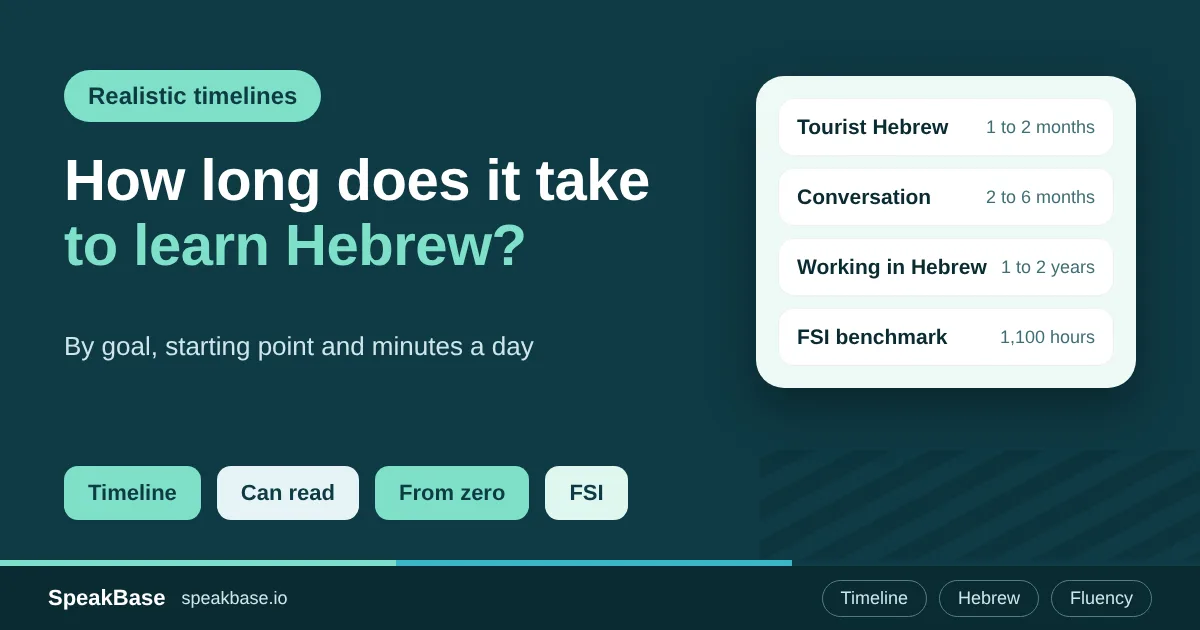
Three months of that puts a Hebrew-school graduate into real conversations: directions, ordering, small talk, a phone call with the in-laws. We wrote up the realistic timelines in how long does it take to learn Hebrew, and the gap between reading and speaking in how to speak Hebrew, not just read it.
FAQ: choosing a Hebrew learning app
Which app is best for learning Hebrew from scratch?
Start with Mango (free with a library card) or Duolingo for the alphabet and the first words, for two to four weeks. Then switch most of your time to an app that makes you speak and corrects you. Starting with speaking from day one is possible on SpeakBase, since Kate explains in English and the screen shows transliteration, but you will go faster if the letters are already familiar.
Is there a free app to learn Hebrew?
Duolingo's Hebrew course is free. Mango is free through many US public libraries. Anki is free. SpeakBase's first conversation is free, with no card. None of the free options corrects your spoken Hebrew except that first SpeakBase conversation.
Can an app really teach me to speak Hebrew?
An app can if it makes you speak and tells you what you got wrong, daily. Apps that only show you Hebrew teach recognition, which is why so many Duolingo graduates can read a menu and cannot order from it. The test is simple: does the app listen to you?
Which app teaches Modern Israeli Hebrew rather than Biblical Hebrew?
All nine apps in this list teach Modern Hebrew. Biblical or prayer-book Hebrew is a different register: same letters, different vocabulary and grammar. If you learned to read in synagogue, that reading transfers; the words mostly do not.
What is the best Hebrew app for someone with an Israeli partner or family?
The one that gets you through Shabbat dinner. That is spoken, fast, informal Hebrew with a lot of listening. Daily spoken practice with role-plays of those exact situations (SpeakBase, or a tutor who will do it) beats any vocabulary app, because the vocabulary you need is small and the courage you need is large.