There is a particular kind of American who wants to learn to speak Hebrew. They went to Hebrew school. They can sound out the letters, often quite well. They have been to Israel, maybe more than once. They have an Israeli cousin, partner or colleague. And when that person says something to them in Hebrew, the whole edifice collapses: they understand half of it, answer in English, and feel ten years old.
If that is you, the good news is that you are not starting from zero and you do not need another reading course. You need a different skill, and it can be built in months, not years, if you practice the right thing. This article is about what that thing is.
Why reading Hebrew does not make you a speaker
Reading and speaking use the same letters and almost nothing else.
Reading is recognition. The word is on the page, it does not move, and you have as long as you like. Speaking is production under time pressure: you have to find the word, put it in the right form, say it with the right stress, and do all of it while another person waits. Those are different mental operations, and training one does very little for the other. A decade of decoding prayer-book Hebrew trains the first. Most apps, built around tapping and multiple choice, also train the first. Nobody told you that the second one needed its own practice.
Hebrew makes this worse than most languages for three reasons.
1. The same letters spell two words
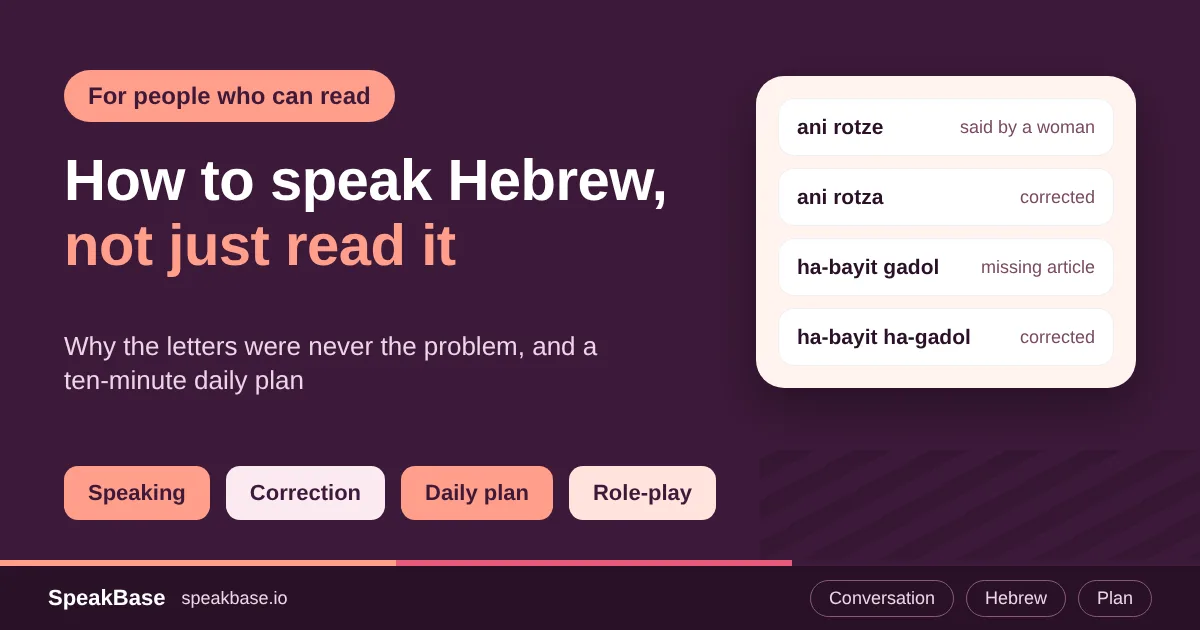
Hebrew is written without vowels, so a written word is often a frame that two or three spoken words share. The word for "want", written רוצה, is pronounced rotze when a man says it and rotza when a woman does. On the page they are identical. Reading never forces you to choose; speaking forces you to choose in every sentence, and English gives you no instinct for it.
2. Everything agrees with everything
Verbs agree with the speaker's gender and number. Adjectives agree with the noun. "You" has four forms: ata, at, atem, aten. A reader can skim past all of this. A speaker has to get it right at speed, and getting it wrong is audible to every Israeli in the room, even though they will be too polite to say so.
3. Prayer-book Hebrew is not café Hebrew
If your Hebrew comes from synagogue, you own a vocabulary of blessing, praise and ancient narrative, and almost none of the words you need to order a coffee, ask where the bathroom is or tell someone about your week. The grammar overlaps; the words mostly do not. Learners are often shocked at how little of their decoding skill transfers to a conversation, and then relieved at how fast the gap closes once they start talking.
The six mistakes English speakers make in nearly every Hebrew sentence
These are the errors a tutor hears from Americans every day. If you learn to catch these six, you are most of the way to sounding like someone who speaks Hebrew rather than someone who reads it.
Mistake | Wrong | Right | Why |
Gender of the verb | Ani rotze (said by a woman) | Ani rotza | Verbs in the present tense carry the speaker's gender |
Gender of "you" | At rotze? (to a man) | Ata rotze? | Four forms of "you"; English has one |
The definite article on the adjective | Ha-bayit gadol (meaning "the big house") | Ha-bayit ha-gadol | The article repeats on the adjective |
The preposition "to" | Ani holech ha-yam | Ani holech la-yam | "To" merges with "the" into la- |
Word order with "there is" | Yesh ani zman | Yesh li zman | "I have" is literally "there is to me" |
Stress on the wrong syllable | TEL-aviv, SHA-lom | Tel-a-VIV, sha-LOM | Modern Hebrew stresses the last syllable far more than English does |
None of these is hard to understand. All of them are hard to produce correctly at speed, which is the whole difference between reading and speaking.
The method: produce, get corrected, repeat tomorrow
Every method that produces speakers has the same three parts, whether it is an Israeli ulpan, a good tutor or an app.
You produce full sentences out loud. Not words, not multiple choice. Sentences, about your own life, in response to a question you did not know was coming.
Someone catches the mistake in the moment and makes you say it right straight away. A correction an hour later is nearly worthless; a correction two seconds later, followed by you saying the right form, is how the right form moves from your knowledge into your mouth.
Yesterday's mistake comes back tomorrow. The forms you get wrong are personal (one learner always drops the article, another never gets "at" and "ata" right) and they only stop when they are drilled specifically.
Ten minutes a day of that beats an hour a week of it, because speaking is a motor skill and motor skills are built by frequency.
A daily plan to learn to speak Hebrew
This is the plan we give people who can already read a little. If you cannot read at all, spend two weeks on the alphabet first (the free alphabet units in Duolingo or Mango are fine), then start here.
Daily, 10 minutes: a spoken conversation with correction
The core. You need something that asks you questions in Hebrew, listens to your answer, corrects it on the spot and explains the correction in English. Three ways to get that:
A tutor, on italki or Preply, $10 to $40 an hour. The best version if you can afford it daily. Almost nobody can, and once a week is too slow for a motor skill.
A language partner, free, if you can find a patient Israeli who will correct you rather than switch to English after thirty seconds. Most switch.
An AI tutor built for exactly this. SpeakBase's Hebrew conversation lessons are ten-minute spoken conversations with Kate, who speaks Modern Israeli Hebrew, corrects your gender agreement, articles and prepositions as you talk, explains each correction in English, and turns your mistakes into review cards for tomorrow. The first conversation is free, five minutes, no card. We built it for this article's reader, which is why it is here; the method above works with any of the three.
Daily, 5 minutes: review your own corrections
Whatever you got wrong today, say it right five times tomorrow. If you use a tutor, write the corrections down and put them in Anki. If you use an app that does this for you, use that.
Daily, in the gaps: listen to real-speed Hebrew
Israeli radio, a Hebrew podcast, Israeli TV with Hebrew subtitles. You will understand a fraction at first. That is fine; the goal is to get used to the speed, which is faster than any course audio.
Weekly, optional: one long conversation with a human
Thirty to sixty minutes with a tutor or a friend, to test what the daily practice built and to find the next set of mistakes.
What to say when you have nothing to say
The second reason reading-only learners freeze is that they have no stock phrases. Here are the ones that keep a Hebrew conversation going when your grammar runs out. Learn them as whole sounds, not as words.
Rega, rega ("wait, wait"): buys you time and sounds completely natural.
Eich omrim... be-ivrit? ("how do you say... in Hebrew?"): the most useful sentence you will ever learn.
Lo hevanti, efshar lehagid od pa'am? ("I didn't understand, can you say it again?")
Yoter le'at, bevakasha ("slower, please")
Ma zeh...? ("what is...?")
Sababa ("great / fine / cool"): agrees with anything.
Say these to an Israeli and watch what happens. They will slow down, they will be delighted, and they will keep speaking Hebrew to you, which is exactly what you need.
Rehearse the conversation you are dreading
Speaking anxiety has a specific cure: rehearse the specific situation. Not "Hebrew conversation" in general, but the actual twelve lines at the falafel stand, the actual phone call to the clinic, the actual Shabbat dinner where your partner's mother asks what you do. Run each one three times with correction before you have to do it for real. The real one will be the fourth attempt, and fourth attempts are calm.
This is what role-play lessons are for: a tutor who will play the taxi driver, or an AI tutor with those scenes built in. Either way, rehearse the specific thing.
Say your first Hebrew sentence to Kate, free
How long until you can hold a conversation?
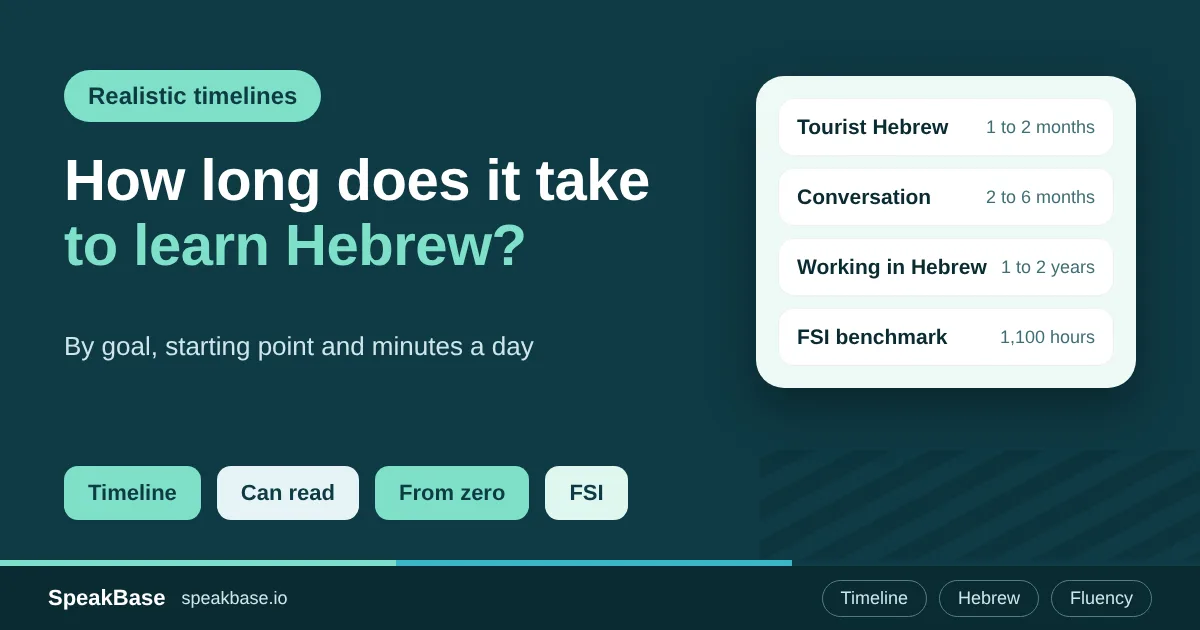
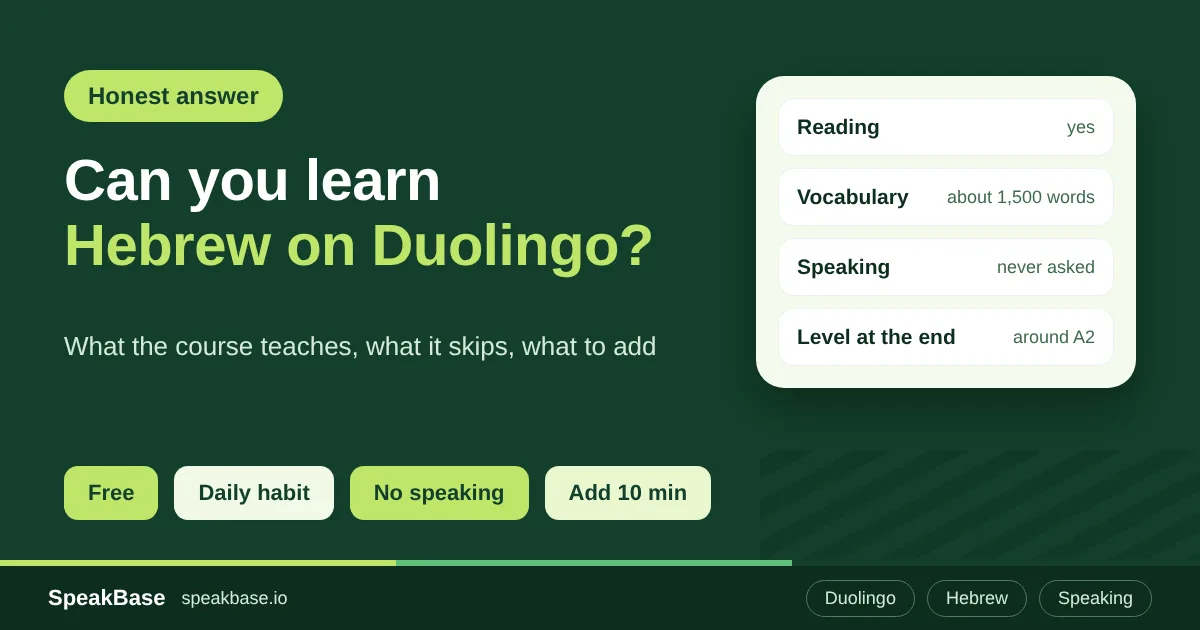
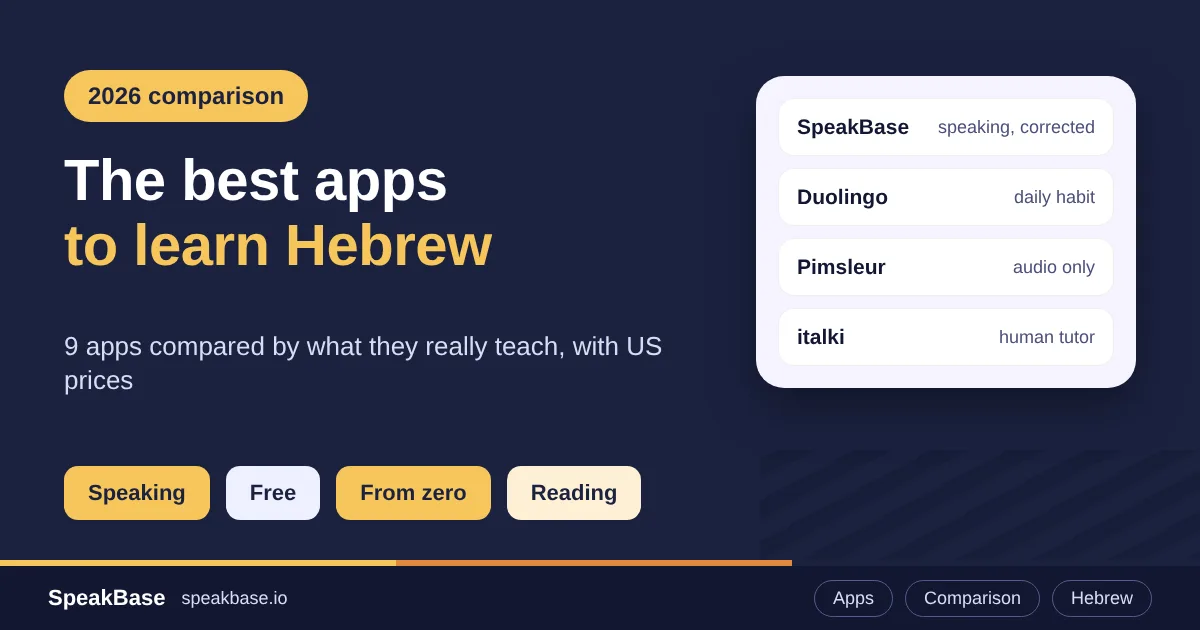
For someone who already reads, with ten minutes of corrected speaking a day: everyday situations (directions, ordering, small talk about your week) in two to three months; a relaxed family dinner, with you taking part rather than smiling, in six to twelve. The full timelines, with the US State Department's figures for comparison, are in how long does it take to learn Hebrew. For a comparison of the apps that can carry the daily part, see the best apps to learn Hebrew, and if Duolingo is your current habit, can you learn Hebrew on Duolingo explains what to add to it.
FAQ: learning to speak Hebrew
Is it hard to learn to speak Hebrew?
Harder than Spanish, easier than Arabic. The US Foreign Service Institute puts Hebrew in its third of four difficulty tiers for English speakers, around 1,100 class hours to professional fluency, against about 600 to 750 for Spanish or French and 2,200 for Arabic. Conversation comes long before professional fluency, and for anyone who already reads, the first conversations come within months.
Can I learn to speak Hebrew without learning to read it?
Yes, and Israeli ulpanim teach new immigrants to speak before they read well. Spoken-first apps with transliteration on screen let you start talking from day one. Reading helps enormously later, so do learn the letters, but do not let them delay the speaking.
How is spoken Hebrew different from written Hebrew?
Faster, more informal, with slang and borrowed English, and with the grammar simplified in places (the future tense often stands in for the imperative, for example). Textbook Hebrew is understood everywhere; it just marks you as a learner.
Do I need to speak Hebrew to live in Israel or visit?
Visit, no: Israelis speak English well. Live, yes, in practice: Hebrew is where friendships, work and family happen, and English keeps you a guest. Most people who move say they wish they had started speaking, not reading, a year earlier.
What is the fastest way to learn conversational Hebrew?
Daily spoken practice with immediate correction, plus listening to real Hebrew every day. Frequency beats duration: ten minutes a day beats an hour on Sunday.