The honest answer to "how long does it take to learn Hebrew" is "to do what?" A tourist who wants to order and ask directions, a grandchild who wants to talk with family in Israel, a new immigrant who needs to work, and a graduate student who needs to read academic Hebrew are learning four different things, and the time ranges from a few weeks to a few years. This article gives you the benchmarks that exist, and then a realistic timeline for each goal.
The official benchmark: 1,100 class hours
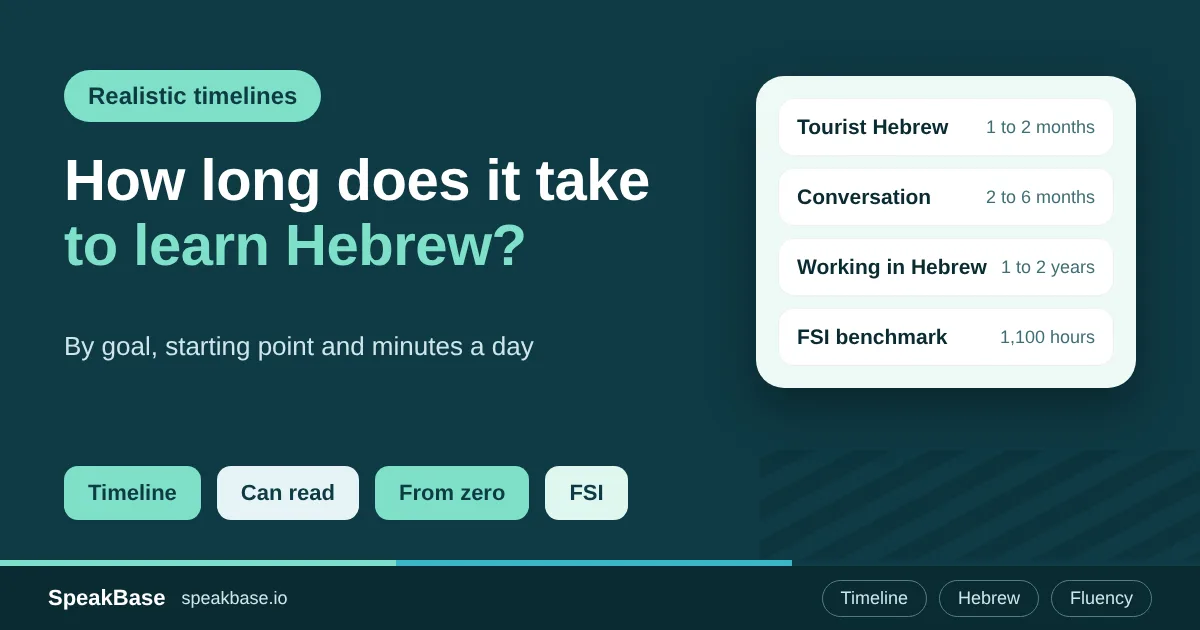
The US Foreign Service Institute, which trains American diplomats, sorts languages by how long its students take to reach professional working proficiency (roughly: you can do your job in the language). Hebrew sits in Category III, the "hard languages" tier, at about 44 weeks of full-time study, or 1,100 class hours. For comparison, Category I languages such as Spanish, French and Italian take 24 to 30 weeks (600 to 750 hours), and Category IV languages such as Arabic, Mandarin, Japanese and Korean take 88 weeks (2,200 hours).
Three things to know about that number before you panic.
It is the figure for diplomats. Professional proficiency means negotiating, reading reports and giving presentations. Nobody needs that to talk to their cousin.
It is full-time classroom study with homework, by adults selected for language aptitude, in a class of six. Your hours are not FSI hours, but their total is a useful ceiling.
Conversation comes much earlier. FSI students are chatting comfortably long before week 44. The curve is steep at the start and flat at the end.
The Israeli benchmark: the ulpan
Israel has been teaching Hebrew to adult immigrants for seventy years in intensive courses called ulpanim. The standard government ulpan for new immigrants, Ulpan Aleph, runs about five months at roughly 25 hours a week, around 500 class hours, and takes an adult from nothing to everyday conversation: shopping, appointments, small talk, simple work situations. Graduates are not fluent. They are functional, and they sound like learners, and they get by. That is a realistic picture of what 500 focused hours buy.
What changes the timeline: three variables
1. Can you already read Hebrew?
This is the biggest single factor for American learners, and the most under-rated. A large share of American Jews learned to decode Hebrew as children. If you can read, even slowly, even only prayer-book Hebrew, you skip the first four to six weeks every absolute beginner spends on the alphabet and on the spelling conventions, and you have an ear for the sounds. What you do not have is production: the ability to say the words. Readers who start speaking practice reach conversation in roughly half the time of true beginners.
2. Minutes per day, not hours per week
Speaking a language is a motor skill, like an instrument, and motor skills are built by frequency. Ten minutes every day beats seventy minutes on Sunday, by a wide margin. Every timeline below assumes daily practice, because weekly practice roughly doubles it.
3. Are you producing or recognizing?
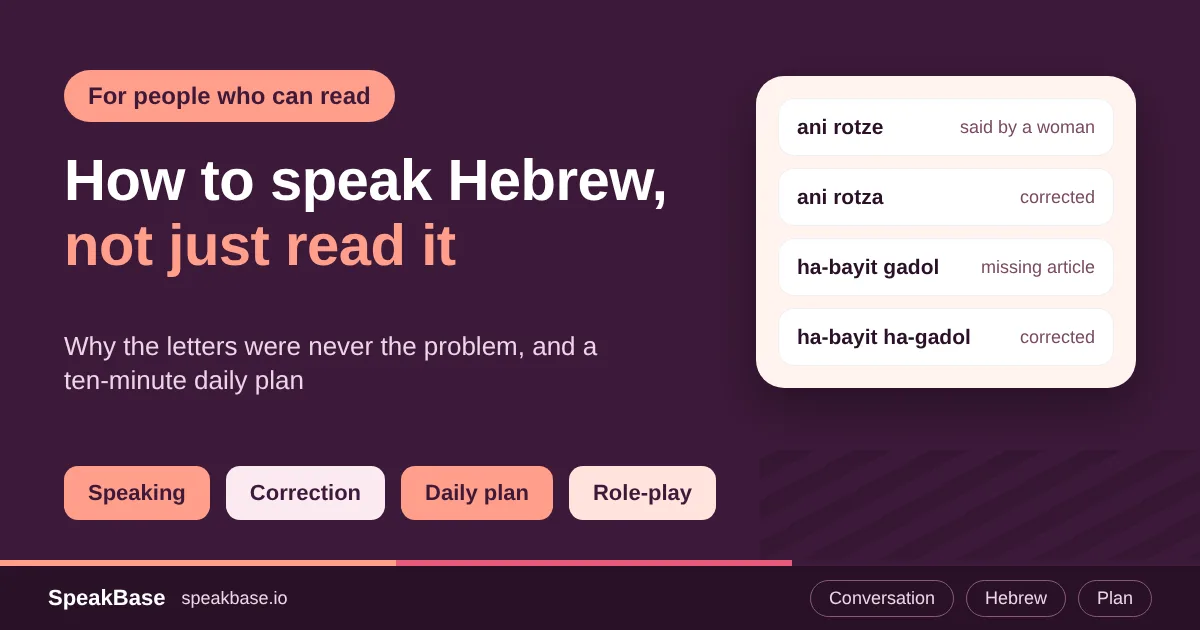
Time spent reading Hebrew sentences and tapping answers trains recognition. Time spent saying Hebrew sentences and being corrected trains production. An hour of the first is worth about ten minutes of the second for the goal of conversation. This is why years of Hebrew school and months of Duolingo leave people unable to speak: the clock was running, but on the wrong skill. We go into this in how to speak Hebrew, not just read it.
Realistic timelines by goal
All of these assume daily practice that includes actual speaking with correction. Double them for recognition-only study.
Goal | Starting from zero | Already read Hebrew |
Read the alphabet, sound out signs and menus | 2 to 4 weeks | Done |
Tourist Hebrew: greetings, ordering, directions, prices | 1 to 2 months | 3 to 5 weeks |
Everyday conversation: your week, your family, simple opinions | 4 to 6 months | 2 to 3 months |
Take part in a family dinner, follow most of it, join in | 9 to 12 months | 5 to 8 months |
Work in Hebrew in a non-technical job | 1.5 to 2 years | 1 to 1.5 years |
Read a newspaper comfortably | 1.5 to 2 years | 1 to 1.5 years |
Professional fluency, the FSI benchmark | 1,100 class hours plus immersion | Somewhat less |
Tourist Hebrew: a month
A trip to Israel needs about 300 words and twenty sentence patterns, and the confidence to use them when the other person answers in fast Hebrew. Four weeks of daily practice is enough, provided the practice is spoken. Israelis speak English well, so you will never be stuck; the reward for a month of Hebrew is the smile when you try.
Everyday conversation: two to six months
This is the goal most American learners actually have: talk with the Israeli relatives, hold your own at the dinner table, text with your partner's family. It needs about 1,000 words (the most frequent 1,000 cover most of everyday speech), the present and past tenses, and the gender agreement that English speakers get wrong in every sentence until it is drilled. For someone who already reads, with ten minutes of corrected speaking a day, this is two to three months to the first real conversations and five to eight to being relaxed at the table.
Working in Hebrew: a year or two
A job in Hebrew, outside tech (where the working language is often English anyway), needs the future tense, the passive forms, a professional vocabulary and the ability to follow a fast meeting. Most immigrants get there in one to two years with an ulpan or intensive study plus daily immersion. It is the stage at which living in Israel makes the biggest difference.
Fluency: years, and nobody agrees what it means
If fluency means talking about anything with Israelis who forget you are a learner, that is several years of daily use, usually in Israel. If it means the FSI's professional proficiency, that is the 1,100-hour figure plus immersion. Most learners should ignore this goal and aim for the one above it; fluency arrives as a side effect of years of conversation, not as a destination you study toward.
Is Hebrew hard to learn for English speakers?
Harder than Spanish, easier than Arabic, and easier than its reputation.
What is hard: the alphabet (two to four weeks, then it is done), writing without vowels (the same letters spell several words, so you need to know the word to read it), gender on verbs and adjectives, and the seven verb patterns, which take a long time to feel natural.
What is easier than people expect: the vocabulary is small and regular (three-letter roots generate families of related words, so once you know k-t-v you get write, writer, letter, written and spelling for free), the tenses are few (past, present, future, no perfect or continuous), there are no cases, and modern Hebrew has absorbed hundreds of English words. Pronunciation is straightforward for English speakers apart from the guttural ch.
How to make it faster
If you can read, stop practicing reading. Spend the time speaking. Your reading will improve as a side effect.
Speak every day, with correction. A tutor, a patient Israeli friend, or an AI tutor built for it. SpeakBase's spoken Hebrew lessons are ten minutes a day with Kate, who corrects your Hebrew as you speak and explains in English; the first conversation is free, no card.
Learn the 1,000 most frequent words, with spaced repetition. Anki or any app with review cards. Not the 5,000 in the dictionary.
Listen to real Hebrew daily, even when you understand a tenth of it. Course audio is slow; Israelis are not.
Measure production, not recognition. Take a spoken level test every month or two rather than counting lessons completed. SpeakBase's free three-minute Hebrew level test grades you on what you say.
Start with a free Hebrew conversation
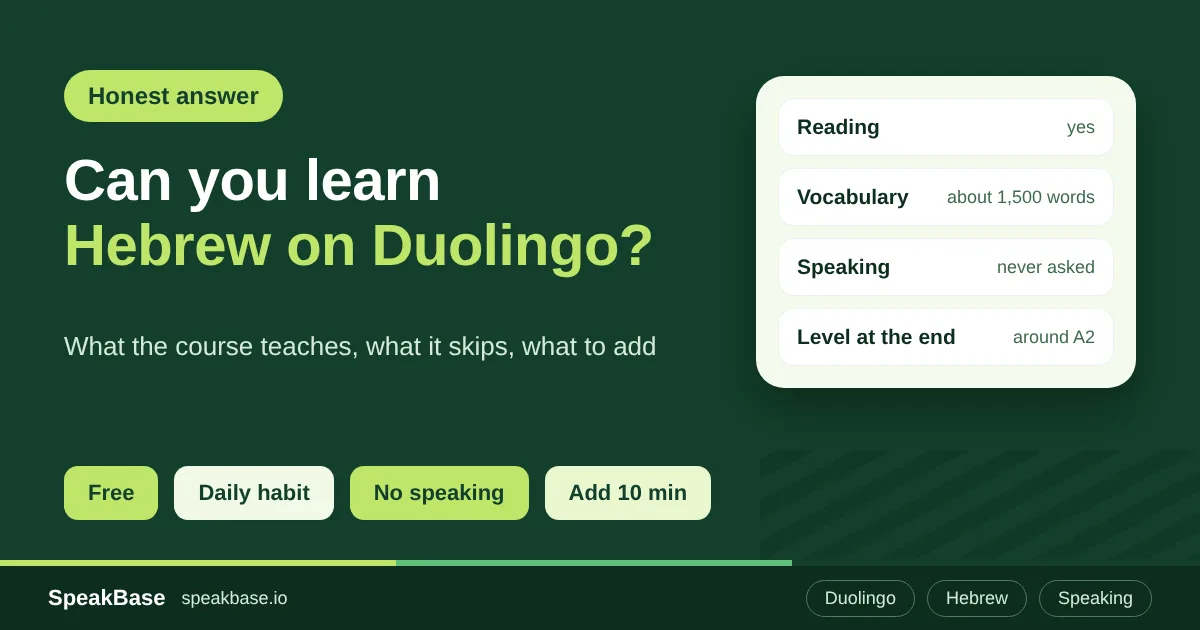
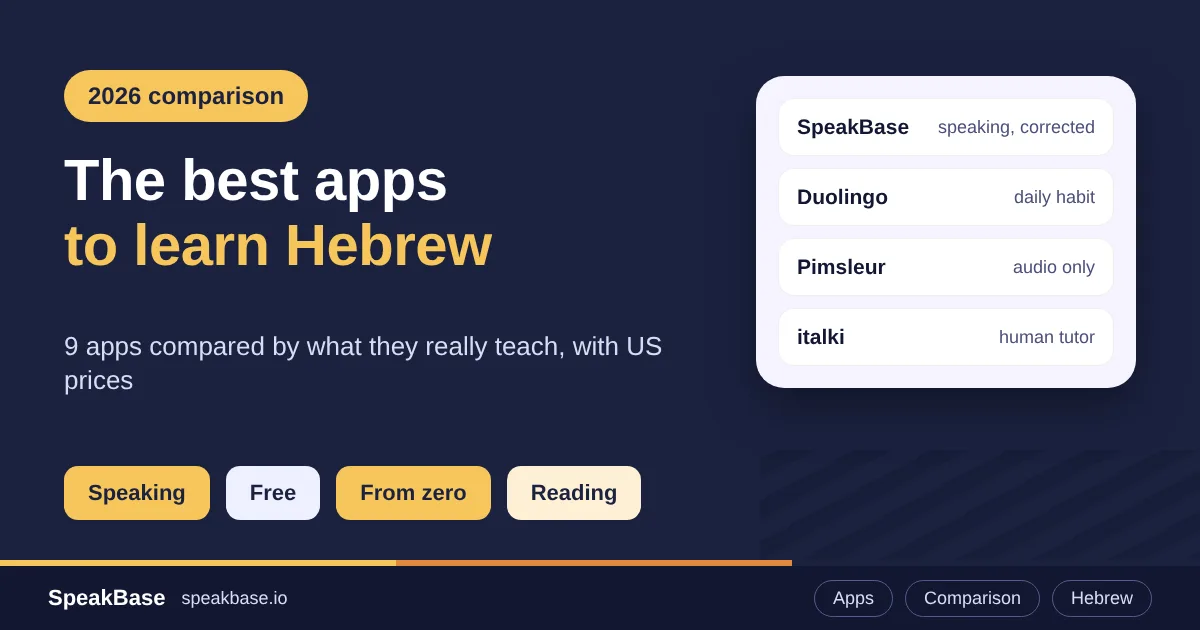
If you are deciding which app to put those daily minutes into, the best apps to learn Hebrew compares nine by what each one trains, and can you learn Hebrew on Duolingo answers the question most people ask first.
FAQ: how long it takes to learn Hebrew
How long does it take to learn Hebrew fluently?
Several years of daily use for conversational fluency with native speakers, and the FSI's 1,100 class hours plus immersion for professional proficiency. Everyday conversation comes far sooner: months, not years.
Can I learn Hebrew in 3 months?
Tourist Hebrew, yes, from zero. Everyday conversation in three months is realistic for someone who already reads Hebrew and speaks with correction every day; for a true beginner it takes four to six.
Can I learn Hebrew in a year?
A year of daily, spoken practice takes a beginner to comfortable everyday conversation and a reader to taking part in family and social life. Working in Hebrew usually takes longer.
How many hours a day should I study Hebrew?
Twenty minutes a day, every day, outperforms two hours twice a week. Ten of those minutes should be speaking out loud with someone or something correcting you.
Is Hebrew harder than Arabic?
No. The FSI rates Arabic at 2,200 class hours against Hebrew's 1,100. Hebrew has a smaller vocabulary, simpler grammar and far less variation between the written and spoken language.
Does knowing Biblical Hebrew help with Modern Hebrew?
With reading, a lot; with speaking, a little. The alphabet and the root system are the same, so a synagogue reader starts well ahead on recognition. The vocabulary of prayer and the vocabulary of a Tel Aviv café barely overlap, and production has to be built from scratch either way.